AUD-EARC-8K: eARC Audio Routing, Formats and EDID
The AUD-EARC-8K passes HDMI 2.1 video to the TV and sends audio to soundbar, amp, optical and L/R at once, with no decoding or downmixing.


A primer on Dante audio networking for AV professionals
Dante is an audio-over-IP networking protocol developed by Audinate. It transports high-quality, low-latency audio over standard managed Ethernet infrastructure — replacing analog cable runs, patchbays, and fixed-channel snakes with a software-defined, fully routable audio network. Any device can send audio to any other device on the same network, in any channel configuration, with routing managed in software via Audinate’s free Dante Controller application.
Dante operates as a Layer 3 IP multicast/unicast audio transport over standard Ethernet. Each device connects via RJ45 to a managed switch. Audio channels are transmitted as UDP/IP packets and received by subscribed devices on the same VLAN.
Two mechanisms underpin Dante: mDNS/Bonjour discovery — devices announce themselves automatically, no manual IP entry required — and PTP clock sync (IEEE 1588) — all devices synchronize to a shared network clock for sample-accurate audio alignment. Clock master role is negotiated automatically.
| Feature | Analog | Dante |
|---|---|---|
| Infrastructure | Dedicated cable per channel | Standard Ethernet — shared |
| Distance | Limited, signal degrades | 100m copper / km via fiber |
| Routing changes | Physical recabling | Software — Dante Controller |
| Signal quality | Susceptible to noise, ground loops | Bit-perfect digital, no degradation |
| Latency | ~0ms | 1ms / 4ms / 10ms (configurable) |
Dante supports PCM audio at 44.1kHz, 48kHz, 88.2kHz, and 96kHz sample rates at 16-bit and 24-bit word depth. All KanexPro Dante products operate at 48kHz/24-bit by default. Audio is transported bit-perfectly — no compression, no lossy encoding, no signal degradation regardless of distance.
AES67 is an IEEE/AES standard defining a common interoperability layer for audio-over-IP systems. Dante devices with AES67 mode enabled can exchange audio with any AES67-compliant device regardless of underlying protocol — Ravenna, SMPTE ST 2110, AES67-native DSPs.
This allows KanexPro Dante products to integrate with DSPs from QSC, Biamp, and BSS; mixers from Yamaha and Allen & Heath; and wireless systems from Shure, Sennheiser, and Audio-Technica — without analog bridging hardware.
A managed network switch is required. Unmanaged switches do not reliably support Dante multicast.
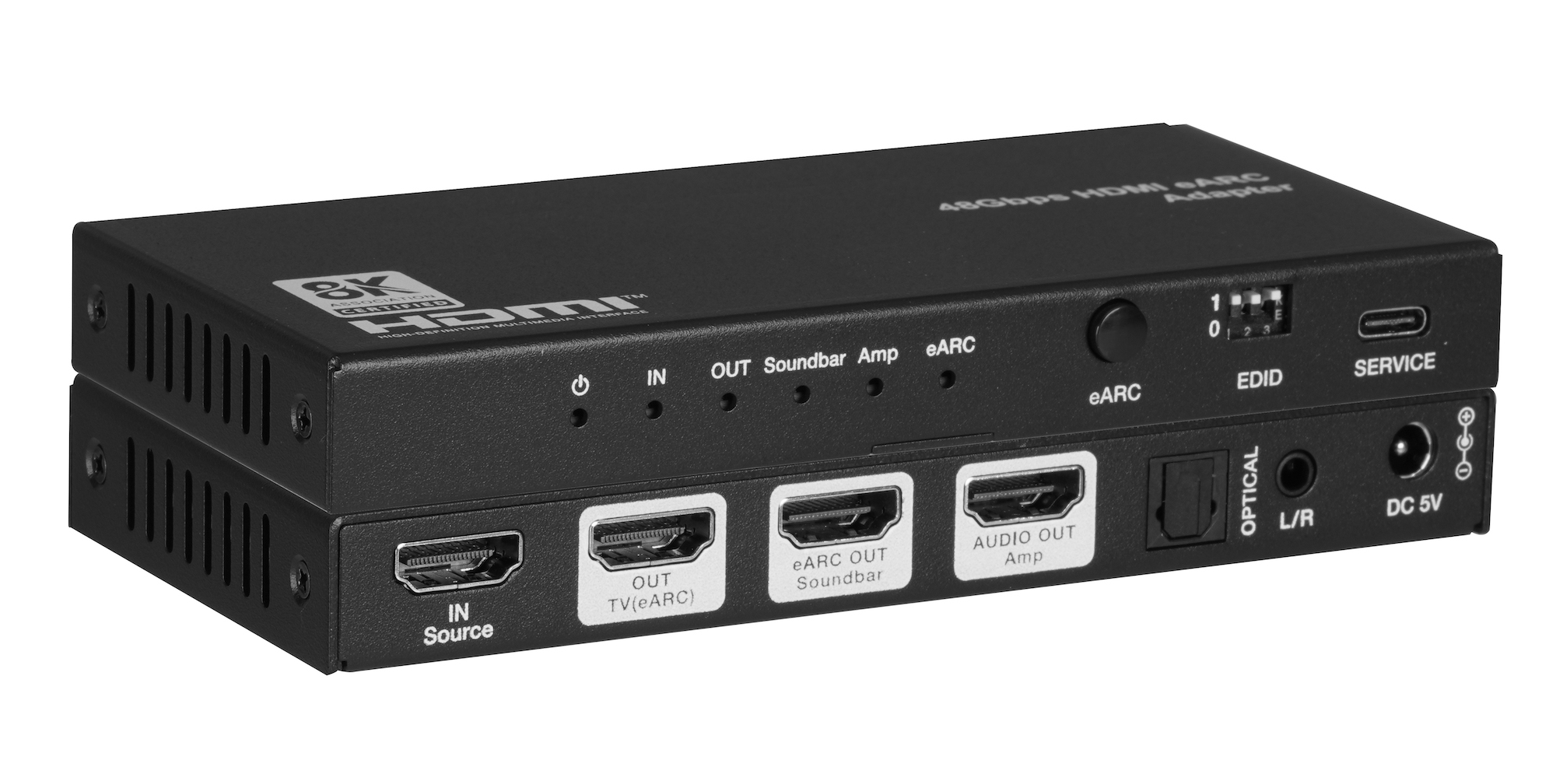
The AUD-EARC-8K passes HDMI 2.1 video to the TV and sends audio to soundbar, amp, optical and L/R at once, with no decoding or downmixing.
How KanexPro checks firmware and software downloads, how to verify a file's SHA-256 fingerprint, what the Windows SmartScreen warning means, and…
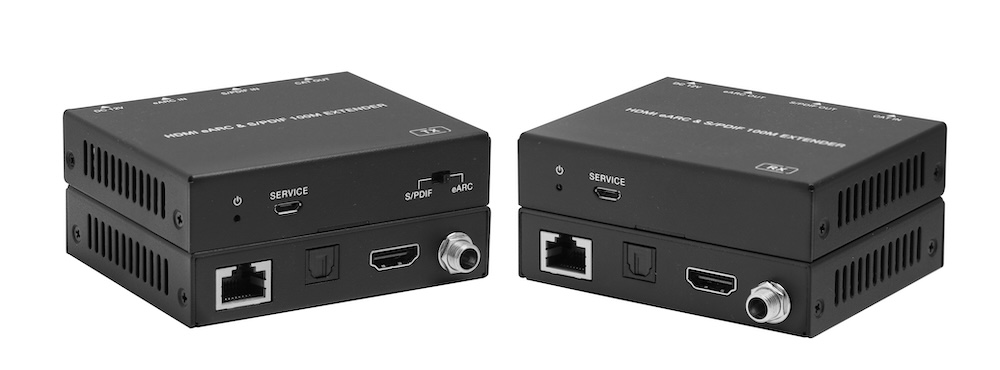
The AUD-EXT-EARC100M carries HDMI eARC or S/PDIF audio from a TV to a soundbar or AVR up to 100m/328ft over one CAT cable, powered from either end.
KanexPro sells direct to dealers, resellers, installers and integrators, and through distribution. Whichever way you buy, the same engineers answer the phone.
The trade store: your own account, live stock, reordering, and a first look at new products.
Go to the trade store →Distribution and authorised resellers across the US and beyond.
See where to buy →Design help on extenders, matrix and AV over IP before you spec it.
Ask an engineer →