Downloading KanexPro software and firmware safely
How KanexPro checks firmware and software downloads, how to verify a file's SHA-256 fingerprint, what the Windows SmartScreen warning means, and…


KanexPro H.265 AV over IP is well-suited for digital signage deployments where bandwidth efficiency is critical and multiple displays need to receive the same content simultaneously. H.265 is the bandwidth-efficient codec in the KanexPro range (JPEG2000 is the visually lossless one): at its default settings a 1080p H.265 encoder sends an 8 Mb/s main stream plus a 1 Mb/s sub stream, making it practical to run many streams over a standard 1G managed network.
H.265 uses multicast by default. One encoder can stream to unlimited decoders simultaneously with no additional bandwidth overhead. A single encoder's stream serves 1 display or 100 displays identically — the network bandwidth cost does not multiply per display.
| Scenario | Encoders | Displays | Total Bandwidth (1080p defaults) |
|---|---|---|---|
| Single channel, 20 displays | 1 | 20 | ~9 Mbps (1 encoder) |
| 4 zones, 5 displays each | 4 | 20 | ~36 Mbps (4 encoders) |
| 2 channels, 50 displays | 2 | 50 | ~18 Mbps (2 encoders) |
Totals use the AVO-IP265HD-ENC defaults: each encoder sends an 8 Mb/s main stream and a 1 Mb/s sub stream at the same time. Both are configurable in the web GUI, so recalculate if you change them. AVO-IP265-4K stream size follows the bitrate type (fixed or variable) and image quality (default 65) set for each encoder in the AVO-IPCTL-265. Apply those settings, then measure an encoder’s throughput at its switch port before sizing uplinks for a 4K system.
How KanexPro checks firmware and software downloads, how to verify a file's SHA-256 fingerprint, what the Windows SmartScreen warning means, and…
Boardrooms, conference rooms, campuses, lobbies — real-world deployment scenarios Corporate AV is among the most practical deployment target for…
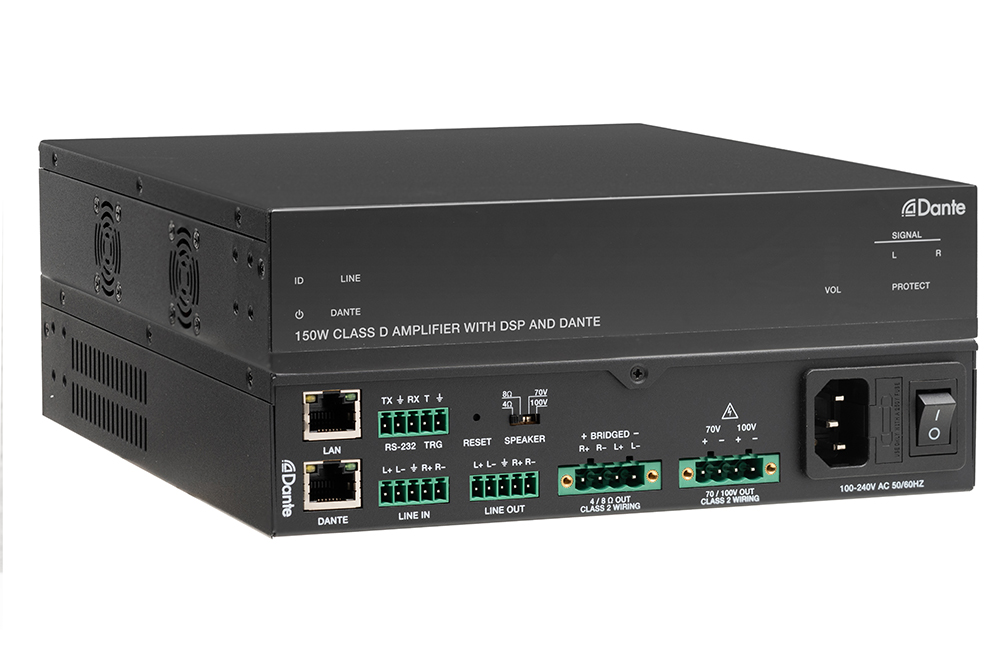
Setup Guide Configuring Your Network Switch for Dante Required switch settings for all KanexPro AUD-DTE- Dante products Dante requires a managed…
KanexPro sells direct to dealers, resellers, installers and integrators, and through distribution. Whichever way you buy, the same engineers answer the phone.
The trade store: your own account, live stock, reordering, and a first look at new products.
Go to the trade store →Distribution and authorised resellers across the US and beyond.
See where to buy →Design help on extenders, matrix and AV over IP before you spec it.
Ask an engineer →