HDMI Distribution System Design: Splitters, Matrices, Scalers and Dante
Specifying an HDMI Distribution System: Splitters, Matrices, Scaling Switchers and Dante Audio Short answer: Choose the device by the shape of the…



Most modern AV systems include some type of HDMI component or connection. HDMI cables might end up being some of the most essential parts of your entire setup, especially if you are looking to convert older audio types. Many customers who visit our Kanex Pro store often wonder what the differences are between the types of HDMI cables available online. Does each type of HDMI cable work differently? Do HDMI cables have different speeds? Which one is the best one for my specific audio setup?
We are happy to help you answer all of these questions and more. Below, we are going to focus on different types of HDMI speeds and the corresponding cable types so you can start to figure out exactly what kind of equipment you need.
It can be easier to understand the different speeds and components of an HDMI cable when you are able to sort it into one of four distinct types. Each type has its own level of speed and may or may not deliver the connection capacity you are looking for:
The most basic type of HDMI cable, standard cables are cheap but are starting to cycle out of use. They can support up to 720p or 1080i up to a bandwidth of 5Gbps. If you are looking to support better 4K options, you might want a more advanced type of HDMI cable.
A high-speed HDMI cable is found in most stores and can support up to 4K and 1080p. This is a good standard cable for those looking to support slightly higher speeds without paying higher costs. Gaming consoles, Blu-ray players, and some computer devices typically operate using high-speed HDMI cables.
Premium HDMI cables, also known as premium high-speed HDMI cables, are a great option for high-fidelity needs. This includes intense gaming with live streaming, along with a multi-device audio connection setup. Audio cables can support up to 8K, along with 4K counterparts. They can allow for some pretty advanced capabilities, such as 4:4:4 chroma sampling with supported bandwidth speeds of up to 18Gbps.
Ultra high-speed HDMI cables are the Cadillac cars of HDMI options, designed to be completely compatible with any kind of device. Not only are they stellar at providing streamlined 4K and 8K resolutions, but they have refresh rates of 60Hz and 120Hz, respectively.
Those with HDR TV devices and top-of-the-line AV systems can take advantage of the ultra high-speed HDMI cable’s capability for 10K viewing. It runs at a bandwidth of a whopping 48Gbps, making it the fastest and most elite HDMI cable option on the market today.
HDMI cables can support many different speeds on their own, but they are not a magic wand for older devices that may not be capable of supporting such a large amount of bandwidth. However, HDMI and Ethernet cables can help influence the speed of both your Internet connection and your AV setups.
Almost all HDMI cables are universal, meaning that you can use almost any kind of cable to transfer almost any kind of video and audio regardless of the quality. There are, however, different types of cables and connectors that may be more specifically designed for your setup.
Looking to browse our wide range of active fiber high-speed HDMI cables, premium HDMI cables, and other high-speed options? Get in touch with one of our experts now to learn about the best options for enhancing your own AV setup.
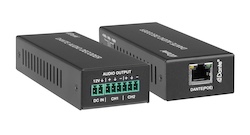
Specifying an HDMI Distribution System: Splitters, Matrices, Scaling Switchers and Dante Audio Short answer: Choose the device by the shape of the…
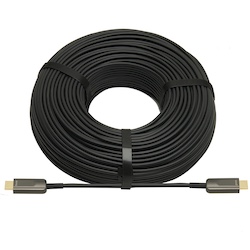
If your source is component video (the red, green, and blue RCA connectors), you need a component to HDMI converter. If it is composite video (a…
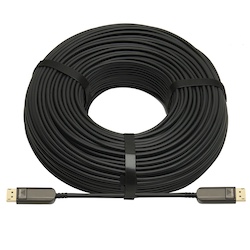
DisplayPort beats HDMI for high-refresh PC monitors and daisy-chaining; HDMI is the pick for TVs, consoles and projectors, and USB-C for laptops.
KanexPro sells direct to dealers, resellers, installers and integrators, and through distribution. Whichever way you buy, the same engineers answer the phone.
The trade store: your own account, live stock, reordering, and a first look at new products.
Go to the trade store →Distribution and authorised resellers across the US and beyond.
See where to buy →Design help on extenders, matrix and AV over IP before you spec it.
Ask an engineer →