One USB-C Cable at the Table for Video, USB Devices and 60W Charging
How one 2-gang wall-plate carries laptop video, USB camera and mic, and 60W charging to a distant display over a single CAT6/6A run.


A USB-C source running DisplayPort Alt Mode is easy to reach when the display is in the same room. Push that same signal across a multi-building campus, a stadium bowl, a hospital between departments or a plant control centre, and the usual answers run out. Copper extension carries a hard ceiling — the overview for this product names a 100m copper limit — so a lecture hall two buildings away or a display cluster across a venue is simply out of range.
The workaround most installers reach for is a source-side dongle that converts USB-C to HDMI, then a second extender to move the HDMI. That adds a fixed adapter hanging off the presenter's laptop or the media player, another point of failure, and a signal chain that can quietly drop to a lower colour sampling. Dense wayfinding text, schematics and reference imagery are exactly where 4:2:0 shows its seams.
And the fibre in the ground is rarely the fibre you would have chosen. A campus backbone might be single-mode; an in-building run might be OM4 multi-mode. An extender welded to one media type forces a compromise on every job.
The EXT-USBC4KFIB-10KM takes a native USB-C DisplayPort Alt Mode source straight onto 10G SFP+ fibre and returns it to native USB-C at the display — no dongle at the source. It is a matched transmitter and receiver pair, each a compact black metal endpoint measuring 3.19 × 1.93 × 0.98 in (81 × 49 × 25 mm) and weighing 0.30 lbs (138 g), powered by its own supply.
The link holds 4K at 60Hz in full 4:4:4 colour with HDR10, HDR10+, Dolby Vision and HLG pass-through, and lossless audio up to Dolby Atmos and DTS:X. Video bandwidth is 32.4 Gbps, supporting HBR3, HBR2, HBR and RBR at 8.1, 5.4, 2.7 and 1.62 Gbps, with colour depth of 8-bit, 10-bit or 12-bit and HDCP 2.3, 2.2 and 1.x compliance. EDID passes from the receiver back to the transmitter, so the source always reads the remote display. Reach is up to 10km at 4K60 over single-mode fibre, with OM4 multi-mode fibre supporting a shorter, plant-matched run instead — you decide by which 10G SFP+ optic you fit, so the fibre plant you already own decides the module, not the extender. SFP+ modules and fibre are selected to match the run and sold separately.
A university pushes a 4K60 wayfinding and event feed from a USB-C media player in the central AV headend to displays in a lecture hall across the fibre backbone. Copper extension is impossible at that distance; a single-mode SFP+ link carries the native USB-C signal end to end at full 4:4:4 with no source-side dongle, and EDID passback keeps the player matched to the remote screen. Over single-mode fibre the run reaches up to 10km at 4K60.
A clinical control room drives a high-resolution reference display in a distant reading room from a USB-C workstation. HDR10 and HDR10+ pass-through preserve the source's tone mapping, and the metal-enclosed endpoints tolerate a rack or plenum location. The fibre run keeps the AV link electrically isolated between rooms — useful where copper ground paths are a concern — while holding 4:4:4 for fine diagnostic detail.
A USB-C capture or playout device at a broadcast position sends 4K60 4:4:4 to a control position or display cluster across the bowl. Single-mode reach of up to 10km at 4K60 covers the longest cable paths in a large venue in a single hop, and the SFP+ modularity lets the integrator match the exact fibre already pulled rather than re-pulling to suit the box.
A SCADA or operations mini-PC with a USB-C output feeds a wall display in a control centre from the plant fibre plant. Lossless audio is largely beside the point here; the deciding factor is guaranteed 4:4:4 video integrity for dense text and schematic detail, where a 4:2:0 path would blur the very content operators depend on. The fibre link carries it without a copper distance limit.
A USB-C laptop in a main boardroom mirrors 4K content to an overflow room in an adjacent building. The link removes the HDMI dongle from the presenter's laptop path. The same TX/RX pair serves both legs. A single-mode optic carries the cross-building leg at 4K60 up to 10km. An OM4 multi-mode optic suits the shorter in-building run instead.
A large property or vessel with a structured fibre backbone extends a USB-C media server or dedicated player to a theatre or salon display well away from the rack. Dolby Vision and Dolby Atmos pass-through preserve the full cinema chain, and the compact endpoints hide behind the display and in the rack instead of committing the install to a bulky, fixed-length AOC cable.
The application diagram is a point-to-point pair:
It supports up to 4096×2160 at 60/50Hz, plus 3840×2160 at 60/50/30/25Hz, 1920×1200p60RB, 1920×1080p60/50, 1280×720p60/50 and any VESA-standard resolution, and holds 4K at 4:4:4. The colour space covers RGB, YCbCr 4:4:4/4:2:2 and YUV 4:2:0. Colour depth is 8-bit, 10-bit or 12-bit.
EDID passes from the receiver back to the transmitter, so the source reads the connected display's capabilities across the run. If the picture is up but the resolution looks wrong, confirm the receiver is powered on with its POWER LED lit and the display is connected to the receiver OUT port.
The green LINK LED stays lit only when the transmitter and receiver have a good optical-fibre connection. If it is off, check the LC fibre between the transmitter SFP+ OUT and the receiver SFP+ IN, and confirm the run matches the fibre type fitted.
Each unit has a SERVICE port — a USB-C update port used for firmware updates — separate from the IN and OUT signal ports.
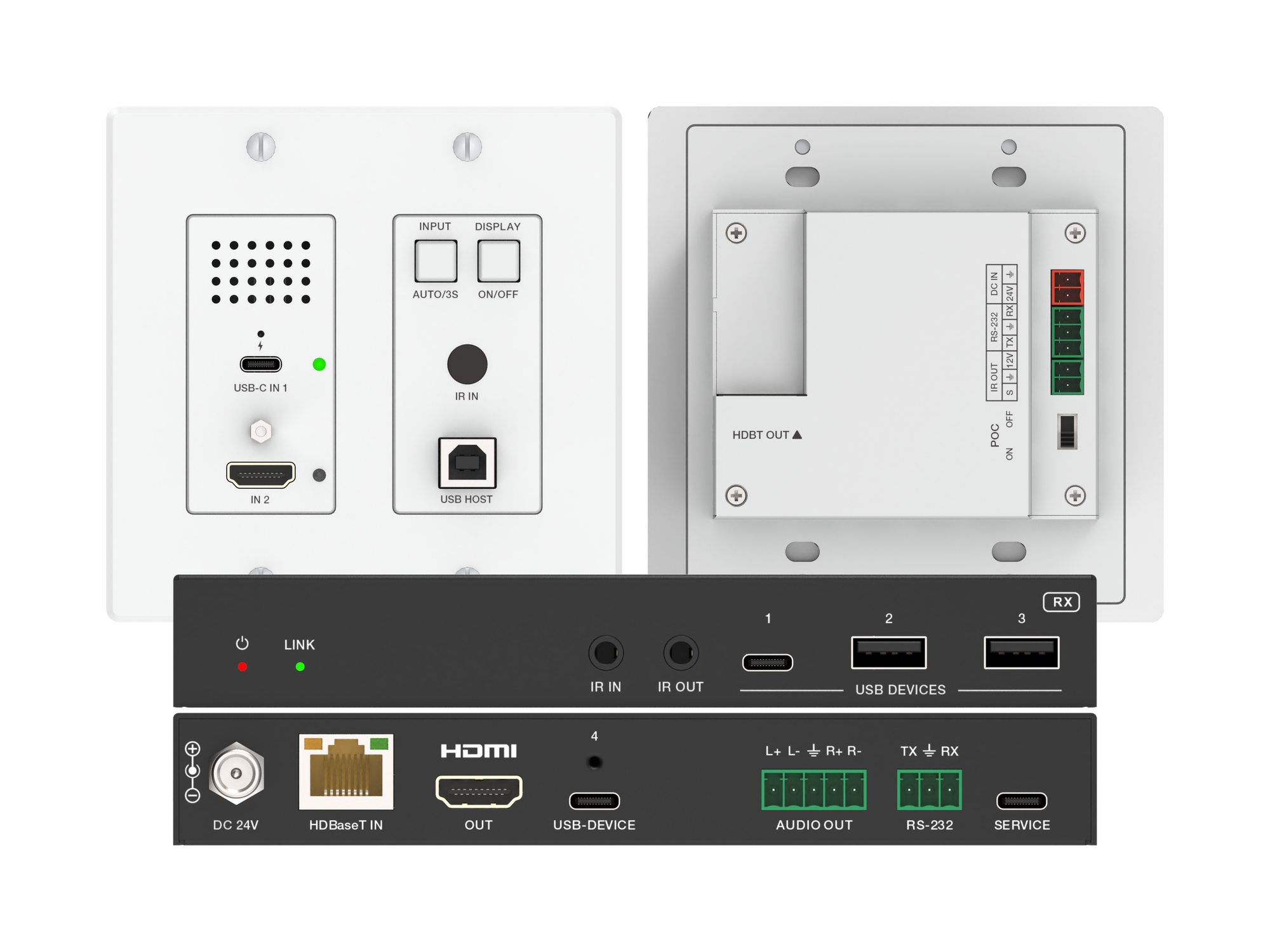
How one 2-gang wall-plate carries laptop video, USB camera and mic, and 60W charging to a distant display over a single CAT6/6A run.
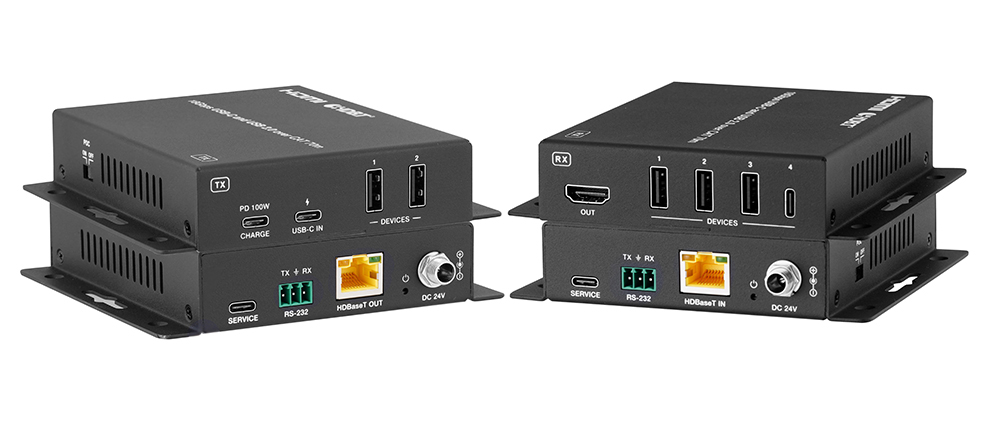
A BYOD room gets designed around the display, the room camera, and the network — and then the actual connection between the laptop and all of it is…
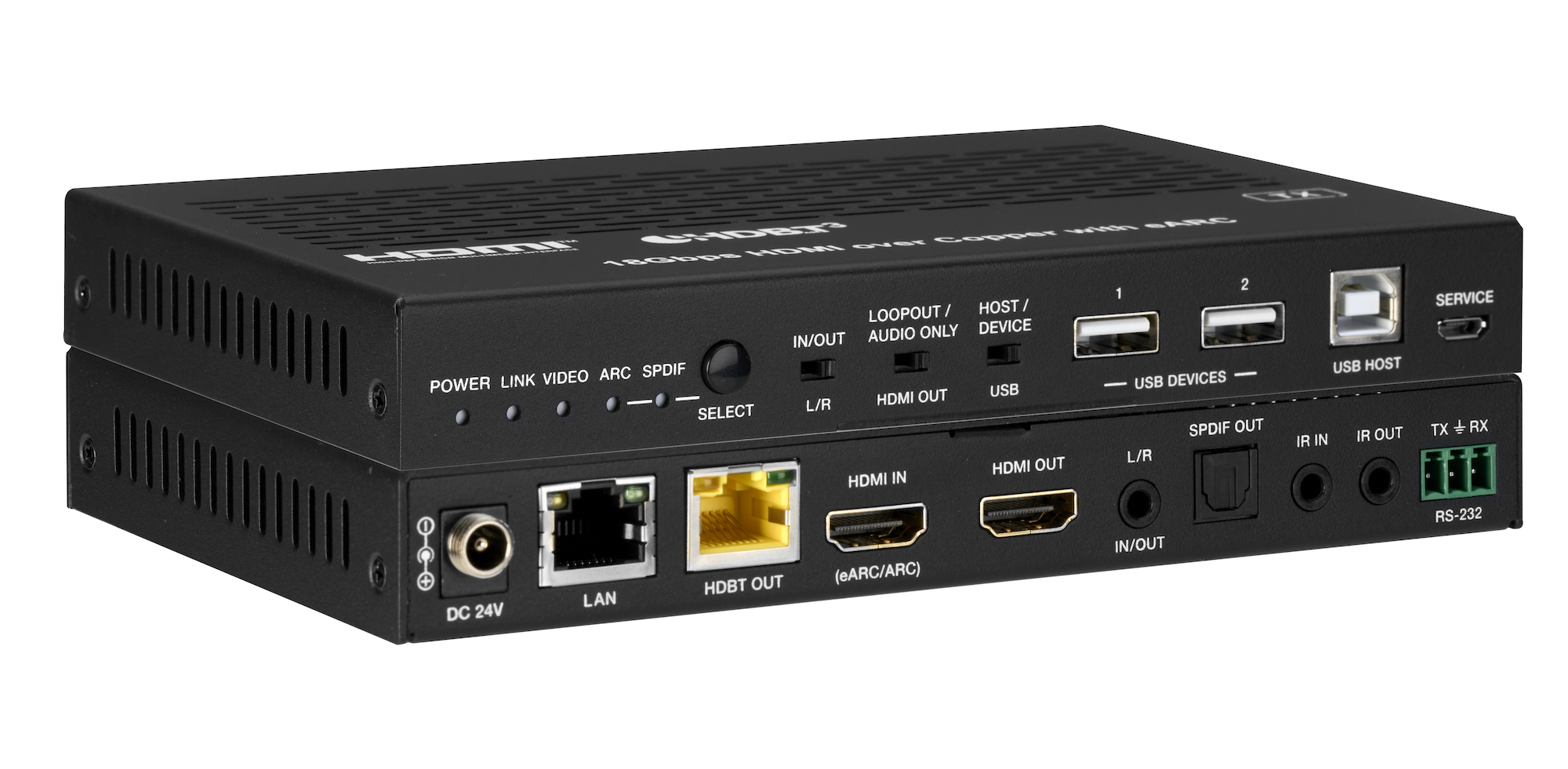
How the EXT-HDBT3ARC-TX carries 4K60 video out to the display and brings eARC audio back down the same CAT6A cable, with USB 2.0, Gigabit Ethernet…
KanexPro sells direct to dealers, resellers, installers and integrators, and through distribution. Whichever way you buy, the same engineers answer the phone.
The trade store: your own account, live stock, reordering, and a first look at new products.
Go to the trade store →Distribution and authorised resellers across the US and beyond.
See where to buy →Design help on extenders, matrix and AV over IP before you spec it.
Ask an engineer →